📈 Case Study 1 – Data-Driven Amazon Listing Optimization
Learn how data-driven analysis turns underperforming Amazon listings into top-ranking, high-converting assets.
📄 Strategic Executive Summary
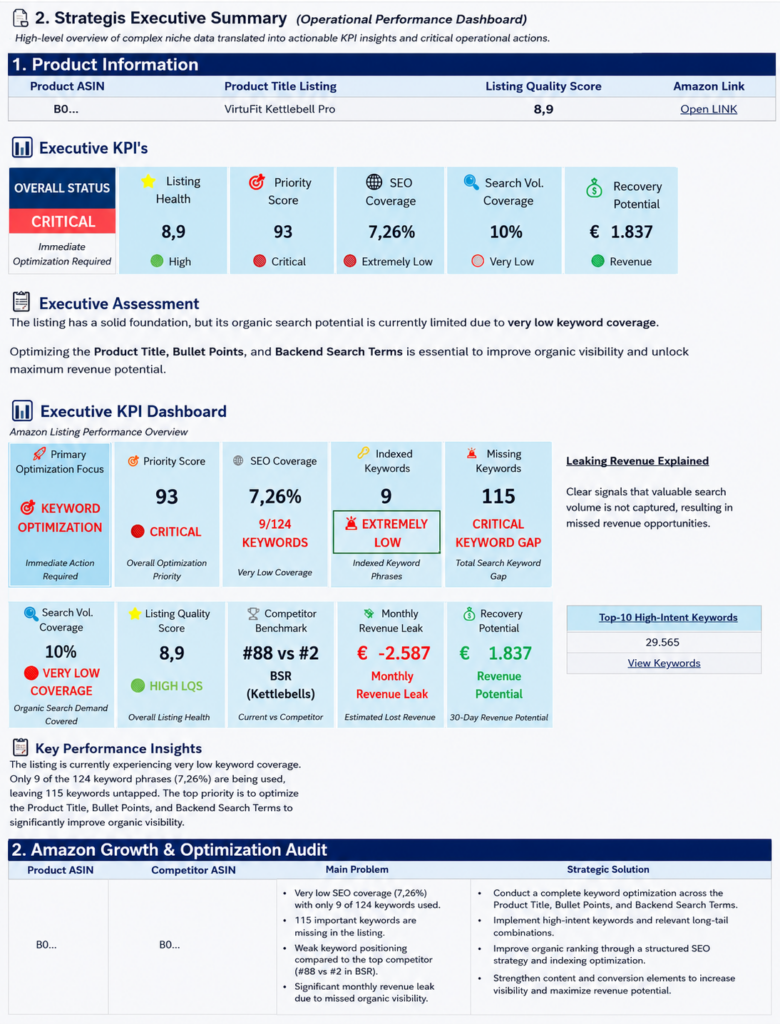
The Executive Summary Dashboard provides an executive-level overview of listing performance, key SEO opportunities, and prioritized optimization actions before the detailed analysis begins.
🎯 Purpose
Transform complex marketplace data into clear executive insights that help prioritize optimization efforts, identify growth opportunities, and support strategic Amazon decision-making.
🔍 Primary Optimization Challenge
The analysis reveals that the listing suffers from extremely low keyword coverage, limiting organic visibility and overall marketplace performance.
• SEO Coverage: 7.26% (9 / 124 keywords indexed)
• Missing Keywords: 115
• Priority Score: 93 (Critical)
• Estimated Monthly Revenue Leak: €2,587
📊 Strategic Analysis
High-value keywords are identified through marketplace data and competitor research, then strategically allocated across:
✅ Product Title
✅ Bullet Points
✅ Product Description
✅ Backend Search Terms
✅ Image Alt Text
This structured approach maximizes keyword indexing while maintaining readability and conversion quality
💡 Business Insight
A high Listing Quality Score alone does not guarantee strong marketplace performance. Limited keyword coverage can significantly reduce visibility, impressions, and long-term organic growth, highlighting the importance of interpreting KPIs together rather than individually.
🎯 Key Business Outcomes
✔ 115 High-Value Keywords Identified
✔ Critical Indexing Gaps Revealed
✔ Clear SEO Priorities Defined
✔ Revenue Opportunities Quantified
✔ Actionable Optimization Roadmap
💼 Business Value
Transform complex Amazon marketplace data into executive-level insights that drive faster, smarter business decisions. Structured KPI dashboards, strategic analysis, and prioritized recommendations reveal the highest-impact optimization opportunities for sustainable marketplace growth.
🚀 Business Impact
✔ Instant Performance Overview
✔ Clear Optimization Priorities
✔ Data-Driven Recommendations
✔ Executive-Level Reporting
✔ Increased Organic Visibility
✔ Prioritized SEO Roadmap
Every recommendation is supported by marketplace data and translated into measurable business actions.
➜ From Summary to Analysis
The Executive Summary identifies what requires attention. The next phase explains why by analyzing each core listing element and establishing a measurable baseline before optimization begins.
📋 Current Listing Analysis
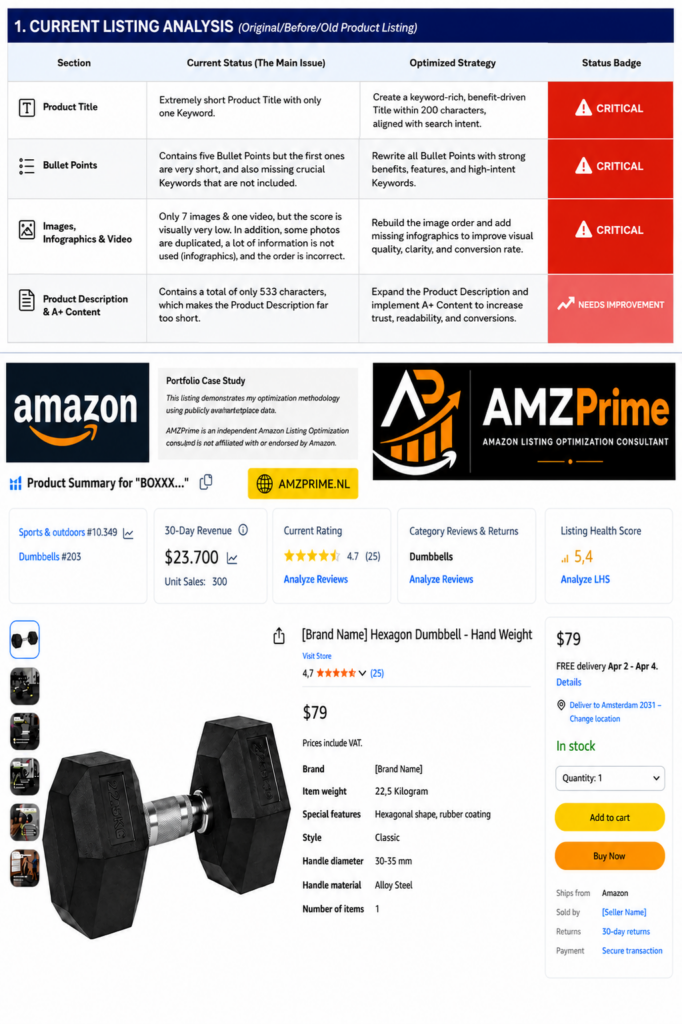
This analysis establishes the baseline performance of the original Amazon listing by identifying the highest-impact optimization issues across the product title, bullet points, images, and product description.
🔴 Key Listing Issues
The original listing contains several critical weaknesses that reduce keyword visibility, conversion potential, and overall listing quality.
- Product title lacks keyword coverage.
- Bullet points miss high-intent search terms.
- Images are limited and poorly structured.
- Product description provides insufficient information.
📊 Analysis Summary
The evaluation focuses on four core listing components that have the greatest influence on Amazon SEO and conversion performance.
- Product Title
- Bullet Points
- Images, Infographics & Video
- Product Description & A+ Content
🎯 Optimization Strategy
Each identified issue is translated into a structured optimization plan designed to improve discoverability and conversion.
- Expand keyword coverage.
- Rewrite conversion-focused content.
- Improve image sequence and infographics.
- Strengthen product description and A+ Content.
💼 Business Value
This analysis converts qualitative listing issues into a structured optimization roadmap, allowing improvement priorities to be identified before implementation begins.
🚀 Expected Business Impact
- Clear optimization priorities
- Improved keyword indexing
- Stronger listing quality
- Higher conversion potential
- Better organic visibility
- Measurable optimization baseline
✨ After Listing Optimization
This section demonstrates how the optimized Amazon listing outperforms the original through strategic Amazon SEO, conversion-focused content, and data-driven optimization. The results highlight measurable improvements in visibility, ranking, customer engagement, and overall marketplace performance.
🟢 Key Optimization Results
The optimized listing successfully addresses the critical weaknesses identified during the initial analysis, resulting in a stronger marketplace presence and improved listing quality.
- Product title lacks keyword coverage.
- Bullet points miss high-intent search terms.
- Images are limited and poorly structured.
- Product description provides insufficient information.
📊 Performance Improvements
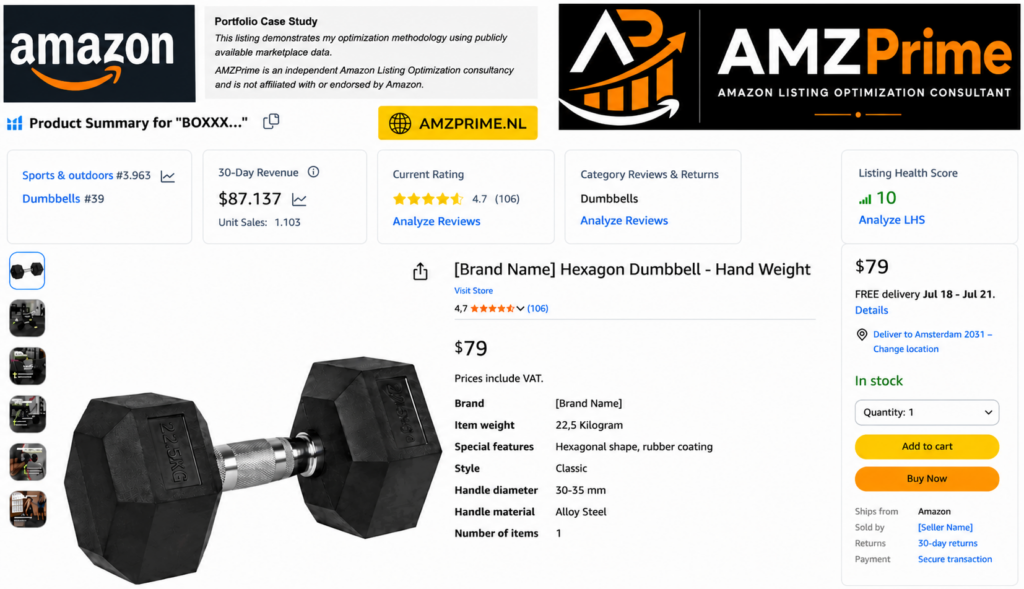
The optimized listing shows measurable improvements across multiple marketplace performance indicators.
✔ Listing Health Score increased from 5.4 to 10.
✔ 30-Day Revenue increased from $23,700 to $87,137.
✔ Estimated Unit Sales increased from 300 to 1,103.
✔ Category Ranking improved from #203 to #39.
✔ Sports & Outdoors Ranking improved from #10,349 to #3,963.
✔ Customer Reviews increased from 25 to 106, while maintaining a 4.7 rating.
✔ Listing Health Score improved from 5.4 to 10
✔ Backend keyword utilization increased from 0 to 248 / 250 bytes
✔ Product Title optimized to 190 / 200 characters
✔ Product Description expanded to 1,661 / 2,000 characters
🎯 Optimization Strategy
Every listing element was strategically optimized using marketplace research, competitor intelligence, and Amazon SEO best practices.
✔ Expanded keyword coverage across the listing.
✔ Enhanced bullet points focused on benefits and conversion.
✔ Improved listing structure and content readability.
✔ Optimized product description for both SEO and customer engagement.
✔ Optimized Backend Search Terms
✔ Expanded Product Description
✔ Implemented Image Alt-Text Strategy
✔ Improved keyword distribution
✔ Enhanced customer readability
✔ Balanced SEO and conversion optimization
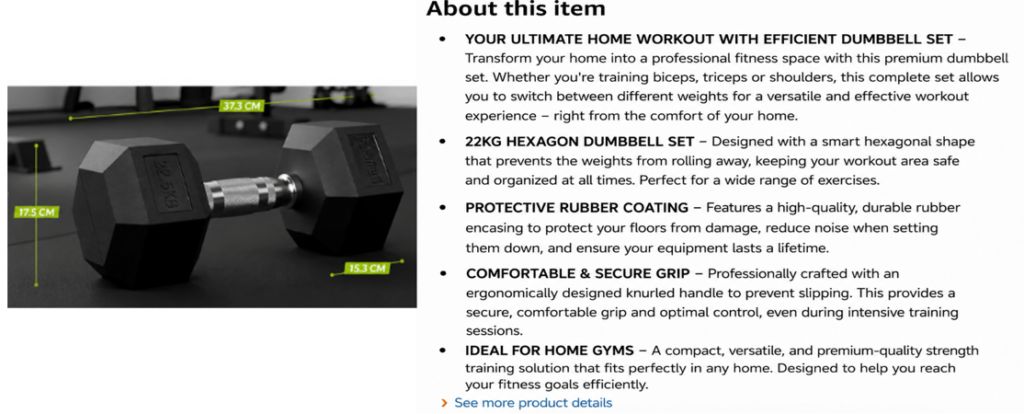
✨ Optimized Bullet Points ⭐
The optimized Bullet Points combine high-intent keywords with persuasive product messaging, ensuring every section improves both Amazon indexing and customer decision-making.
✔ Key Improvements
✔ Stronger keyword integration
✔ Benefit-focused copywriting
✔ Improved readability and scanability
✔ Clear product differentiation
✔ Better feature presentation
✔ Natural SEO implementation
✔ Higher customer engagement
🔍 Listing Highlights
✔ Keyword-rich Product Title
✔ Benefit-driven Bullet Points
✔ Structured Product Description
✔ High-quality Product Images
✔ Optimized Product Specifications
✔ Improved Listing Health Score
✔ Stronger Customer Trust
✔ Conversion-focused Layout
💼 Business Value ⭐
This optimization framework transforms marketplace intelligence into measurable listing improvements through structured SEO implementation, customer-focused content, and executive-level optimization priorities. Every recommendation is designed to improve indexing, visibility, conversion potential, and long-term marketplace performance.
🚀 Expected Business Impact
- Increased organic search visibility.
- Higher keyword indexing potential.
- Improved marketplace ranking.
- Stronger conversion performance.
- Increased sales and revenue.
- Higher Listing Health Score.
- Better customer trust and engagement.
- Executive-level optimization supported by measurable KPIs.
- Better product discoverability
- More competitive marketplace positioning
➜ From Listing Optimization to Competitor Intelligence
The optimized listing establishes a strong SEO foundation. The next phase shifts from internal optimization to external marketplace analysis, identifying competitor keyword strategies, market positioning, and additional opportunities for sustainable long-term growth.
✨ SEO-Optimized Amazon Listing
The original listing has been completely restructured using Amazon SEO best practices, strategic keyword placement, and conversion-focused copywriting. Every core listing element was optimized to improve discoverability, customer engagement, and marketplace performance.
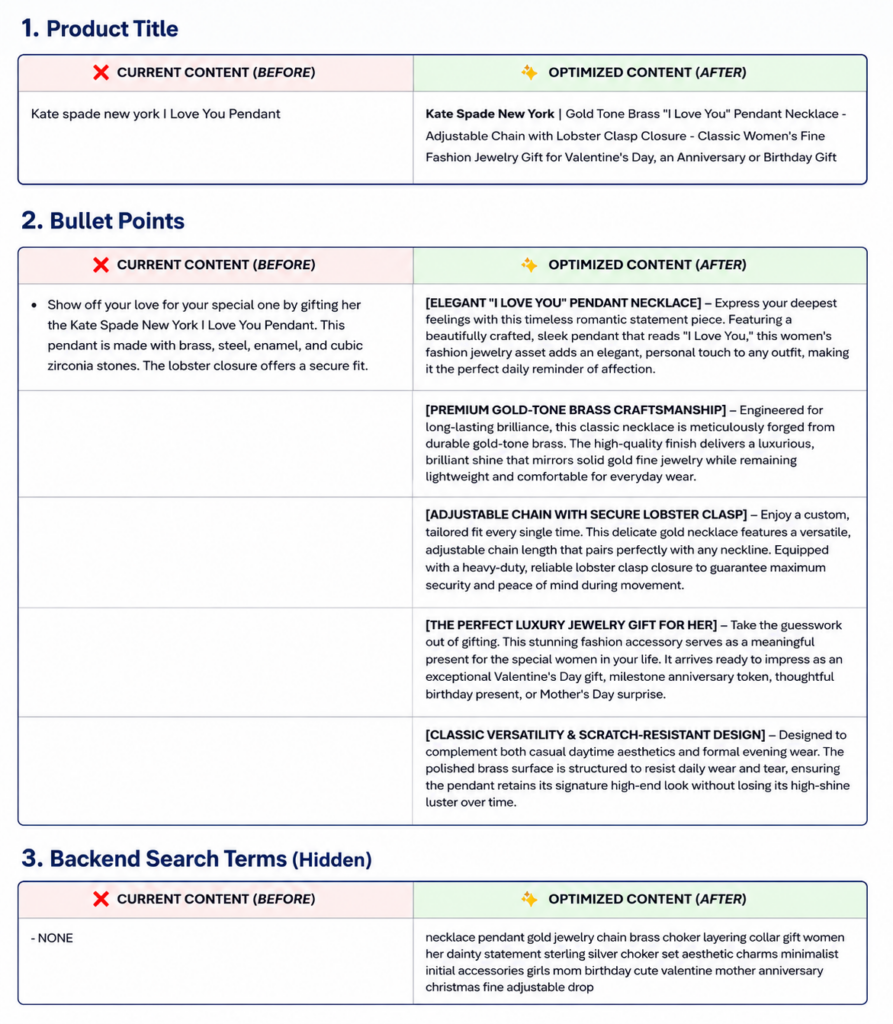
📝 Product Title Optimization
The original product title contained only a limited number of keywords and provided little information about the product. The optimized title expands keyword coverage while clearly communicating the product’s key features, material, intended use, and target audience.
- Expanded keyword coverage.
- Improved search relevance.
- Better product clarity.
- Increased indexing potential.
📋 Bullet Point Optimization
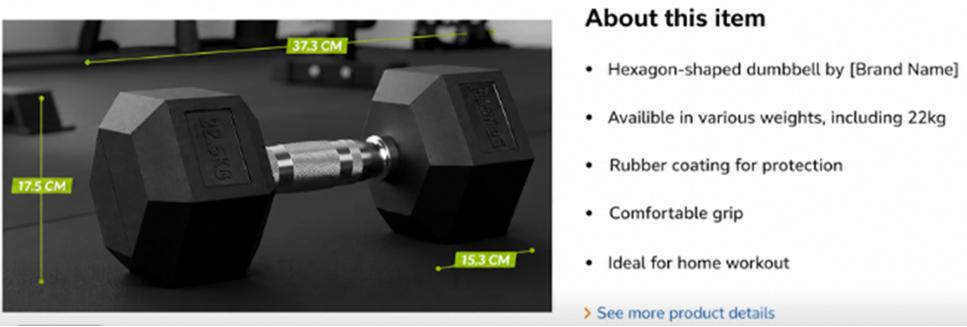
The original bullet points provided only basic product information and failed to communicate customer benefits or target important search terms. The optimized bullet points combine Amazon SEO with persuasive copywriting to improve both discoverability and conversion potential.
- Benefit-driven product messaging.
- High-value keyword integration.
- Improved readability and structure.
- Stronger customer engagement.
- Enhanced conversion-focused content.
🔍 Backend Search Terms
The original listing did not utilize hidden backend search terms, resulting in missed indexing opportunities. The optimized backend search terms introduce additional high-value keywords that strengthen Amazon’s understanding of the product without affecting the customer-facing content.
- Expanded keyword indexing.
- Improved search discoverability.
- Additional long-tail keyword coverage.
- Stronger marketplace relevance.
💼 Business Value
Optimizing every listing component creates a stronger foundation for Amazon SEO by combining strategic keyword placement with customer-focused content. This structured approach improves both search visibility and conversion performance while supporting long-term organic growth.
🚀 Expected Business Impact
- Improved keyword indexing.
- Higher organic visibility.
- Better search relevance.
- Stronger product discoverability.
- Increased conversion potential.
- Enhanced customer experience.
- More competitive marketplace positioning.
- Sustainable long-term SEO performance.
➜ From Listing Optimization to Competitor Intelligence
With the listing fully optimized, the next phase focuses on competitor analysis to identify additional keyword opportunities, benchmark marketplace performance, and uncover strategic advantages for long-term growth.
📝 Product Description & Image SEO Strategy
The product description and image optimization strategy strengthen both customer experience and Amazon SEO. Together, they improve product discoverability, communicate key benefits, and maximize keyword relevance across visible and hidden listing elements.
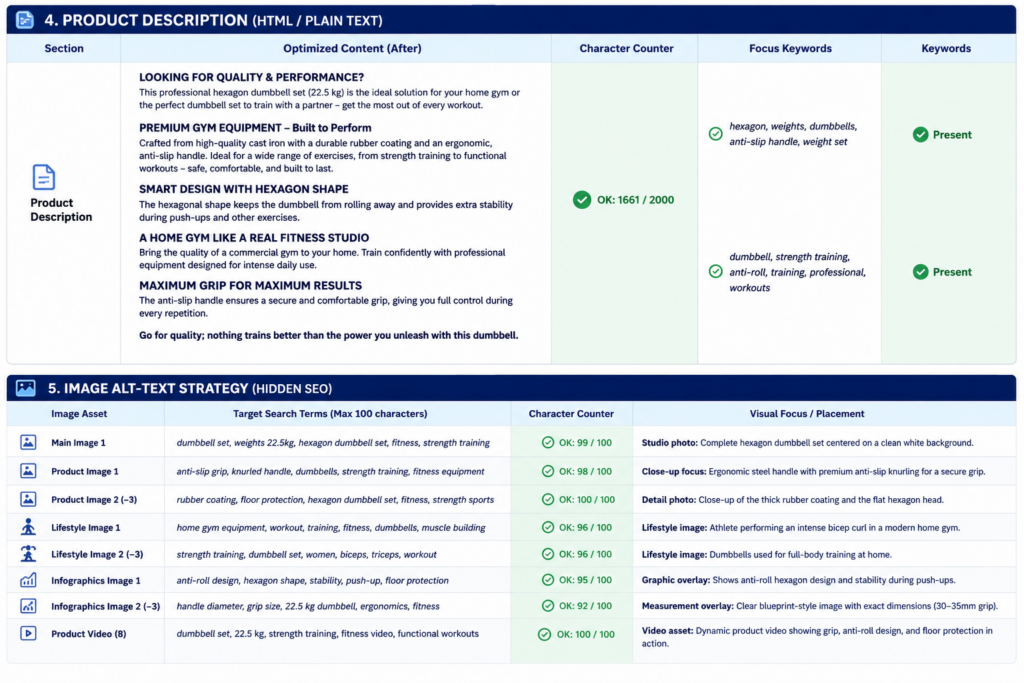
📄 Product Description Optimization
The optimized product description expands the original listing with structured, benefit-driven content while naturally integrating high-value keywords. This improves readability, customer confidence, and overall listing quality.
- Structured and easy-to-read content.
- Benefit-focused product messaging.
- Strategic keyword integration.
- Optimized character usage.
- Stronger customer engagement.
🖼️ Image Alt-Text Strategy
Every product image has been assigned targeted search terms that reinforce the listing’s SEO strategy. Although customers do not see these elements, they provide additional context for search indexing and ensure each visual asset supports the overall optimization framework.
- SEO-focused image optimization.
- Targeted keywords for every image.
- Consistent keyword distribution.
- Strategic visual placement.
- Enhanced marketplace relevance.
📊 Optimization Summary
The product description and image strategy work together to create a complete, customer-focused listing while strengthening Amazon’s understanding of the product through structured content and keyword relevance.
- Optimized product description.
- Complete image SEO strategy.
- Balanced keyword distribution.
- Improved listing consistency.
- Enhanced customer experience.
💼 Business Value
Combining optimized product descriptions with a structured image SEO strategy creates a comprehensive listing that supports both discoverability and conversion. Every content element contributes to stronger marketplace visibility while reinforcing a consistent customer experience.
🚀 Expected Business Impact
- Stronger keyword relevance.
- Improved organic visibility.
- Better customer engagement.
- Higher content quality.
- Enhanced image discoverability.
- Increased conversion potential.
- Consistent SEO implementation.
- Sustainable long-term marketplace performance.
➜ From Optimization to Competitor Intelligence
With the product content and image strategy fully optimized, the next phase evaluates competitor listings to identify additional keyword opportunities, benchmark performance, and uncover strategic advantages for continued marketplace growth.
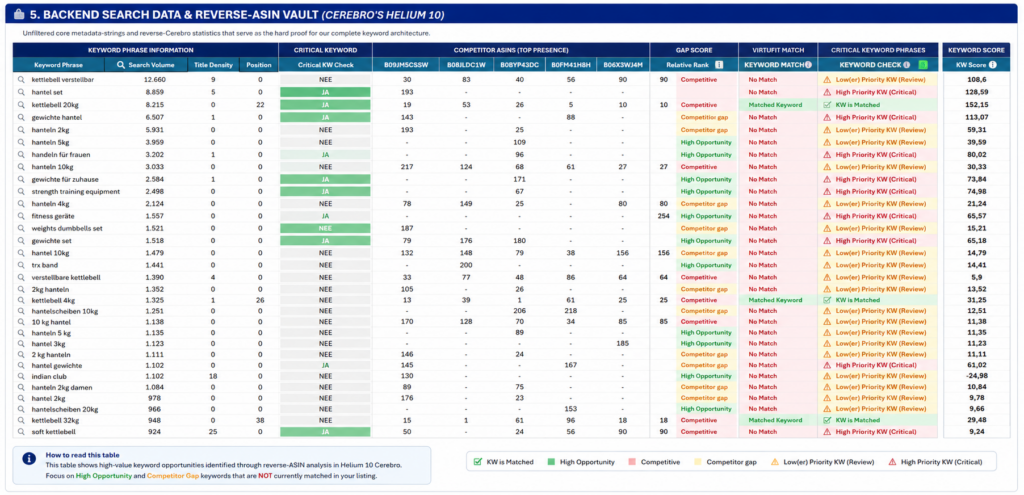
🔍 Competitor Keyword Intelligence (Reverse-ASIN Analysis)
This analysis leverages Helium 10 Cerebro to uncover high-value keyword opportunities through Reverse-ASIN research. By comparing competitor keyword coverage with the current listing, hidden indexing gaps and strategic optimization opportunities can be identified.
🎯 High-Value Keyword Opportunities
The Reverse-ASIN analysis identifies keywords that generate traffic for competing products but are currently missing or underutilized in the listing.
- High-search-volume keyword opportunities.
- Critical keyword gaps identified.
- Untapped indexing potential.
- Priority keywords for optimization.
📊 Competitive Keyword Intelligence
Competitor ASIN analysis reveals which keywords successful listings rank for and highlights areas where the current listing can improve its competitive positioning.
- Reverse-ASIN competitor comparison.
- Keyword presence across competing listings.
- Competitive keyword benchmarking.
- Marketplace positioning insights.
🚀 Keyword Optimization Strategy
Each keyword is evaluated based on search volume, competitive relevance, indexing status, and optimization priority to create a structured keyword implementation roadmap.
- Prioritize high-value keywords.
- Close competitor keyword gaps.
- Improve keyword indexing.
- Strengthen backend search relevance.
- Build a comprehensive keyword architecture.
💼 Business Value
Reverse-ASIN analysis transforms competitor marketplace data into actionable SEO intelligence. Rather than relying on guesswork, keyword decisions are driven by real competitor performance, allowing optimization efforts to focus on the opportunities with the highest potential business impact.
🚀 Expected Business Impact
- Expanded keyword coverage.
- Improved organic keyword indexing.
- Reduced competitor keyword gaps.
- Stronger marketplace competitiveness.
- Higher search visibility.
- Data-driven keyword prioritization.
- Increased long-term organic growth.
➜ From Keyword Intelligence to Strategic SEO Roadmap
The identified keyword opportunities are consolidated into a structured SEO roadmap, prioritizing implementation based on search volume, competitive importance, and expected business impact
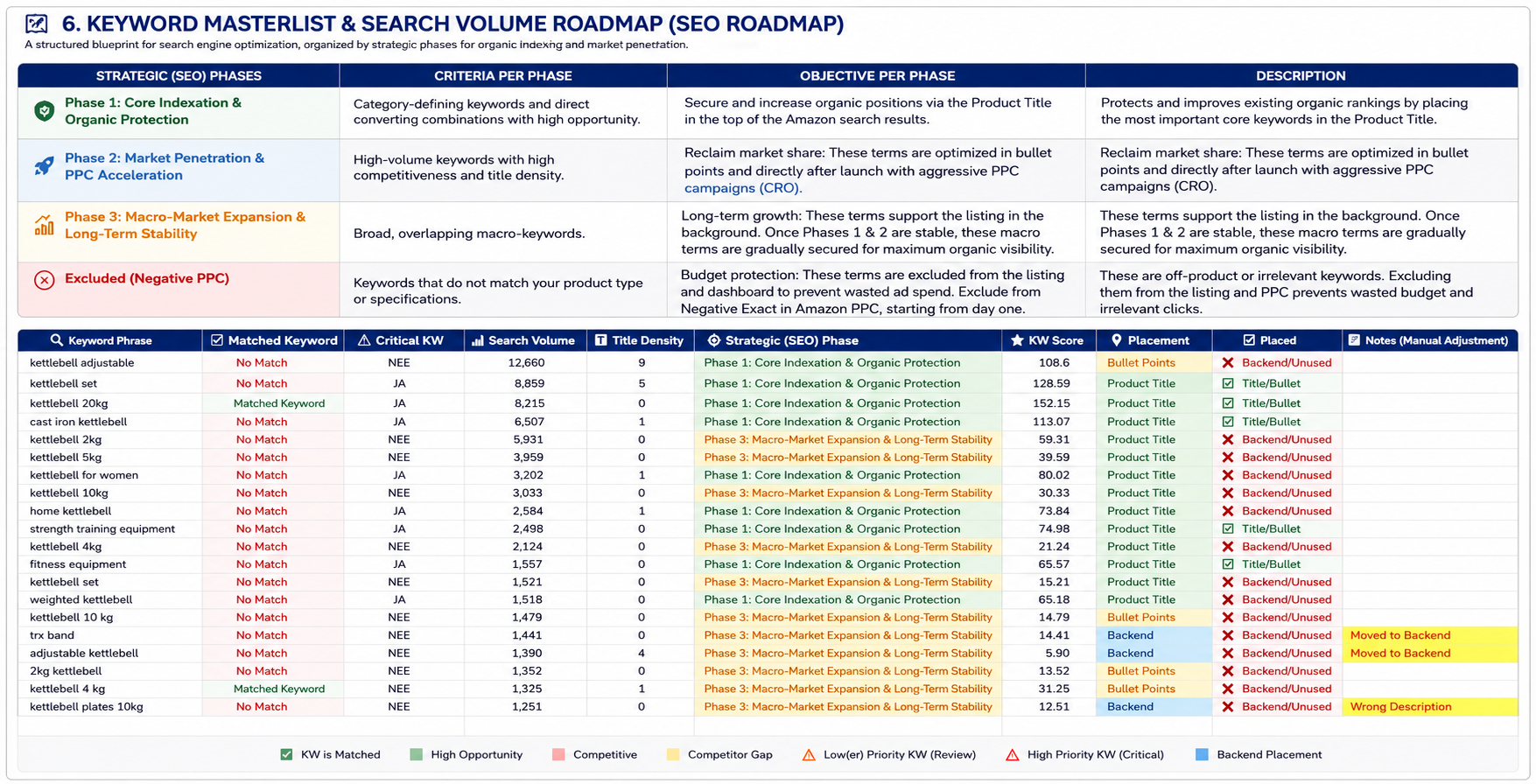
🗺️ Keyword Masterlist & SEO Roadmap
This strategic SEO roadmap transforms keyword research into a structured implementation plan. Every keyword is prioritized according to search volume, competitive importance, placement, and business impact to maximize long-term organic visibility.
🎯 Strategic SEO Phases
Keywords are organized into structured implementation phases to ensure the highest-impact opportunities are optimized first while supporting sustainable long-term marketplace growth.
- Phase 1: Core Indexation & Organic Protection.
- Phase 2: Market Penetration & PPC Acceleration.
- Phase 3: Macro-Market Expansion & Long-Term Stability.
- Exclude irrelevant keywords from PPC campaigns.
📊 Keyword Prioritization
Each keyword is evaluated using multiple performance indicators to determine where and when it should be implemented within the Amazon listing.
- Search volume analysis.
- Competitive keyword evaluation.
- Title density assessment.
- Keyword scoring.
- Strategic placement recommendations.
🚀 Implementation Strategy
Rather than placing keywords randomly, each keyword is assigned to the most effective listing element to maximize indexing and conversion performance.
- Prioritize high-value keywords.
- Optimize Product Title placement.
- Strengthen Bullet Point relevance.
- Expand Backend Search Terms.
- Build a scalable keyword architecture.
💼 Business Value
The Keyword Masterlist provides a clear implementation framework that transforms raw keyword research into a structured SEO strategy. By assigning every keyword a priority, placement, and optimization phase, implementation becomes measurable, repeatable, and aligned with long-term marketplace growth.
🚀 Expected Business Impact
- Structured keyword implementation.
- Stronger keyword indexing.
- Improved organic rankings.
- Better search visibility.
- Reduced keyword overlap.
- Higher marketplace relevance.
- Scalable SEO strategy.
- Sustainable long-term organic growth.
➜ From SEO Roadmap to Strategic Performance Analysis
With the keyword roadmap complete, the final phase evaluates how the implemented optimization strategy translates into measurable marketplace performance through executive KPI dashboards and strategic business reporting.
🧭 Data-Driven Optimization Framework
Rather than applying isolated SEO improvements, this project follows a structured optimization framework in which every phase contributes to a measurable business outcome.
Consultancy Workflow
- 📊 Executive Summary Dashboard
- 🔍 Current Listing Analysis
- 🚀 Amazon Listing Optimization
- 📝 Product Description & Image SEO
- 🔎 Reverse-ASIN Competitor Intelligence
- 🗺️ Keyword Masterlist & SEO Roadmap
- 📈 Strategic SEO Dashboard